

Cybersecurity Job Statistics and Trends: Navigating the 2025 Landscape
Picture this: It’s 3 AM, and you, a CISO at a major healthcare network, are wide awake, scrolling through LinkedIn desperate to find just one qualified incident response analyst. Down the hall, your cybersecurity professional has just completed his fourth certification this year but still can’t land his first role. Meanwhile, in Indianapolis—yes, Indianapolis—tech companies are offering six-figure salaries and signing bonuses that would make Silicon Valley jealous.
This is the paradox of cybersecurity jobs: a field bursting with opportunity yet starved of talent, where geography no longer dictates destiny, and where the rules of the game change faster than you can update your threat intelligence feeds. This is where cybersecurity job statistics come in to help answer the following question.
The Million-Dollar Question: Where Did All the Cybersecurity Professionals Go?
The numbers are staggering, almost unbelievable:
3.5 million cybersecurity positions sit empty worldwide.
That’s not a typo—it’s enough unfilled roles to populate the entire city of Los Angeles.
But here’s where it gets interesting. The existing workforce of 4.7 million professionals barely grew by 0.1% last year. Yet demand exploded by 8.1%.
This isn’t just about entry-level positions—seasoned professionals are as rare as unicorns, and just as mythical to most hiring managers.
As organizations across industries confront increasingly complex and frequent cyber threats, the demand for skilled cybersecurity professionals has reached unprecedented levels.
In 2025, the cybersecurity job market reflects both immense opportunities and significant challenges. This comprehensive analysis explores current job market statistics, emerging trends, sector-specific dynamics, salary expectations, and the future outlook of cybersecurity careers.
The Growing Workforce Gap
| Metric | Value |
| Global cybersecurity workforce | ~4.7 million |
| Unfilled roles worldwide (2025) | ~3.5 million |
| Workforce growth (2024) | +0.1% |
| Demand growth (2024) | +8.1% |
Countries like the United States, United Kingdom, Germany, Canada, and Mexico have all reported net declines in available cybersecurity talent. This critical imbalance underscores the urgent need for long-term strategies focused on workforce development, training, and retention.
Employment Growth and Future Projections
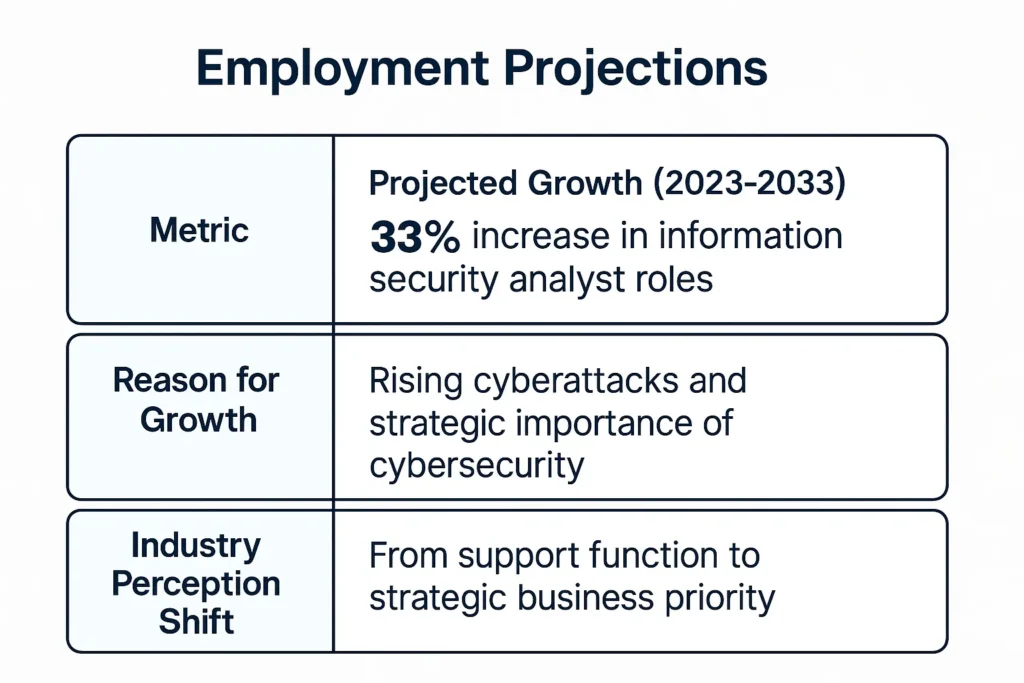
According to the U.S. Bureau of Labor Statistics, the role of Information Security Analyst is projected to grow by 33% between 2023 and 2033—a rate significantly higher than the average across all occupations. This sharp rise is fueled by the increasing frequency and severity of cyberattacks, which demand robust defensive capabilities and highly skilled personnel.
Cybersecurity is no longer seen as a technical or support function; it is a core business priority. This recognition has elevated the field to a strategic concern at the executive level, prompting companies to invest more in cybersecurity hiring, training, and infrastructure.
The Great Cybersecurity Salary Divide: Where Your Career Path Truly Matters
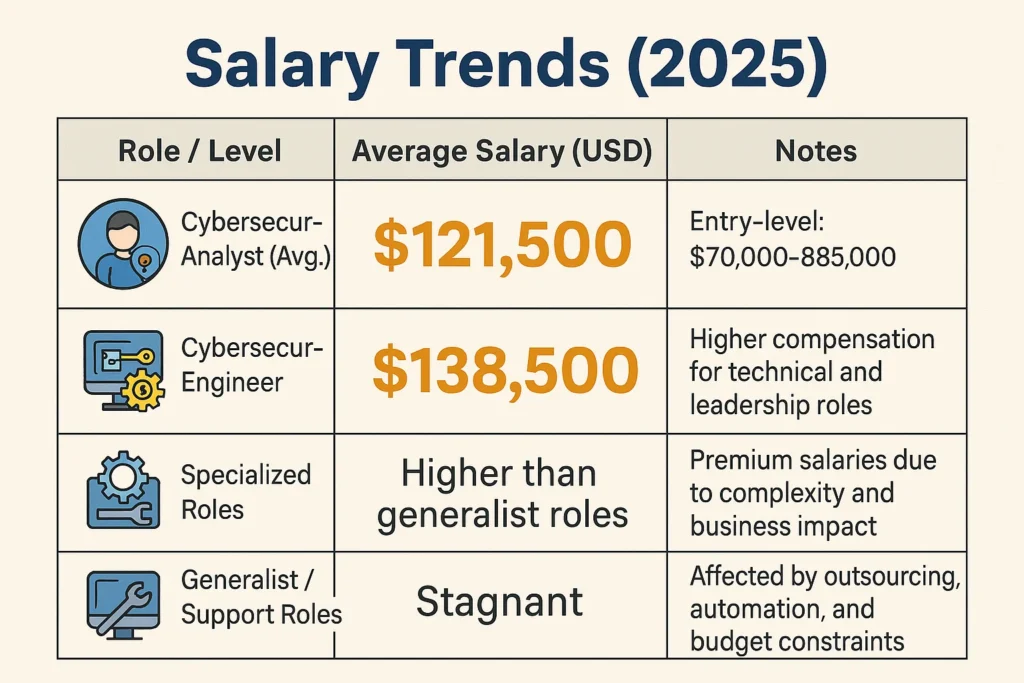
The cybersecurity job market in 2025 tells a fascinating tale of two worlds—on one hand, specialized roles like cybersecurity analysts and engineers command impressive six-figure salaries averaging $121,500 to $138,500, reflecting the industry’s desperate hunger for skilled professionals.
Meanwhile, with a projected 33% growth rate in employment for information security analysts from 2023 to 2033, these premium salaries aren’t just numbers—they’re market signals of unprecedented demand. However, the data reveals a stark reality:
While technical and leadership positions thrive with robust compensation packages, generalist and support roles face stagnation, increasingly threatened by outsourcing and automation.
Entry-level positions start at $70,000 and senior roles can exceed $200,000, yet the key differentiator isn’t just experience—it’s specialization. Ultimately, this salary landscape sends a clear message to cybersecurity professionals: either develop deep expertise in high-demand areas like threat analysis and security engineering, or risk being left behind in an increasingly competitive and automated field.
Geographic Hotspots and Regional Insights
Cybersecurity job growth is not limited to traditional tech hubs. Indianapolis, Indiana, for example, has emerged as a leading cybersecurity hotspot, experiencing a 31.8% increase in job growth and a 17.2% rise in wages year-over-year. Similarly, Raleigh, North Carolina, and Cleveland, Ohio, have seen growth rates of 59% and 60%, respectively.
| Region | Job Growth YoY | Wage Growth YoY |
| Indianapolis, IN | +31.8% | +17.2% |
| Raleigh, NC | +59% | — |
| Cleveland, OH | +60% | — |
These developments reflect the decentralized nature of cyber threats and the realization that cybersecurity talent is essential across all regions and industries. Companies in smaller metropolitan areas are now offering highly competitive compensation packages to attract top-tier talent, leveling the playing field for both job seekers and employers.
Salary Landscape and Compensation Trends
The compensation for cybersecurity professionals remains robust, with significant upward mobility based on specialization and experience. As of 2025:
| Position | Average Salary |
| Cybersecurity Analyst | $121,500 |
| Cybersecurity Engineer | $138,500+ |
| Entry-Level Roles | $70,000–$85,000 |
However, the real earning potential lies in specialized and leadership roles. Cybersecurity architects, incident response experts, and compliance officers in regulated industries often earn well above average. Conversely, generalist roles face increasing pressure from automation and outsourcing, resulting in slower salary growth.
In-Demand Skills and Areas of Specialization
The cybersecurity skill set is continuously evolving as emerging technologies, regulatory changes, and new threat vectors are reshaping the core competencies employers seek.
Top Skills in 2025:
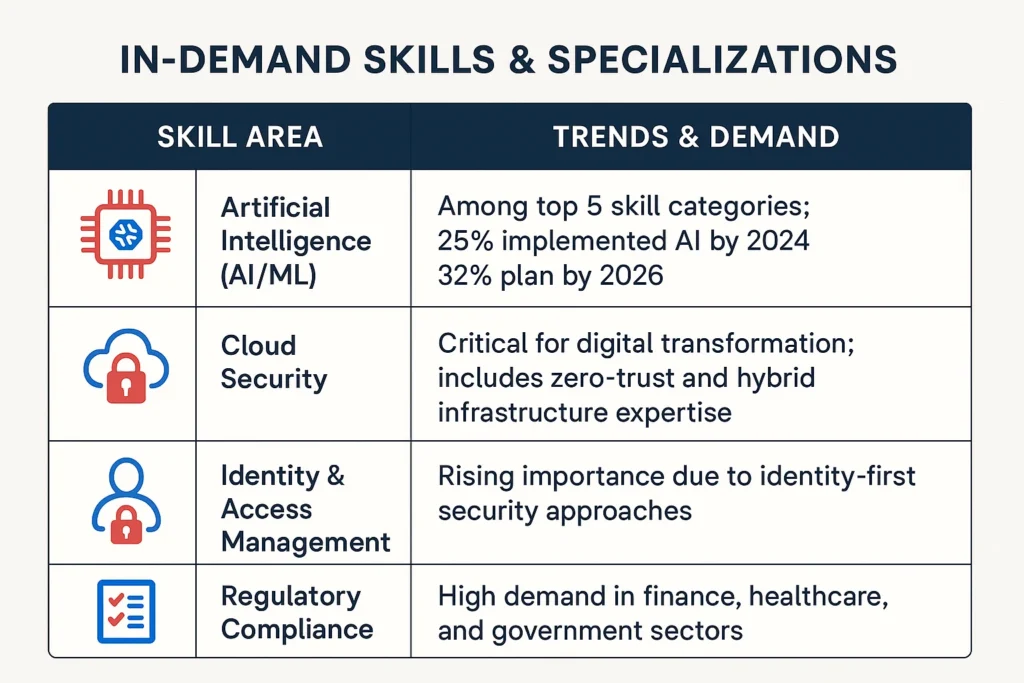
- Artificial Intelligence & Machine Learning (AI/ML): As both a tool and a threat, AI proficiency is now essential. As of early 2024, 25% of companies had integrated AI into their security strategies, with another 32% planning adoption.
- Cloud Security: The global shift to cloud computing has created soaring demand for professionals skilled in AWS, Azure, GCP, and zero-trust architecture.
- Identity and Access Management (IAM): The rise of identity-first security policies has increased demand for IAM experts.
- Compliance & Regulatory Knowledge: Professionals familiar with frameworks like GDPR, HIPAA, NIST, and ISO 27001 are increasingly sought after, especially in healthcare, finance, and government sectors.
| Skill Area | Demand Level | Key Tools/Frameworks |
| AI & Machine Learning | Very High | Python, TensorFlow, PyTorch |
| Cloud Security | High | AWS IAM, Azure AD, GCP IAM |
| Identity Management | High | SAML, OAuth, OpenID Connect |
| Regulatory Compliance | High | GDPR, HIPAA, NIST, ISO 27001 |
The convergence of technical, regulatory, and business skillsets is becoming the new norm in cybersecurity hiring criteria.
Sector-Specific Dynamics
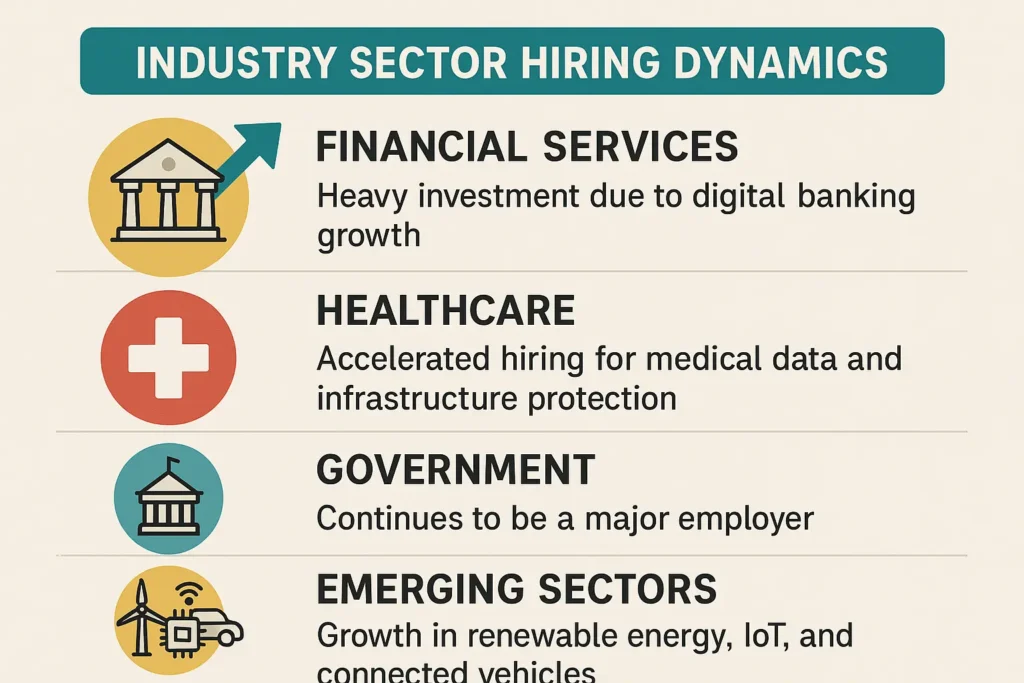
While cybersecurity is relevant across all sectors, some industries exhibit particularly high demand:
- Financial Services: With the proliferation of digital banking, cybersecurity is vital for protecting financial assets and complying with regulatory standards.
- Healthcare: The digitization of patient records and sensitive data has increased investment in healthcare cybersecurity teams.
- Government & Defense: National security and critical infrastructure protection remain top priorities, requiring a broad spectrum of cyber talent.
- Emerging Industries: Sectors like renewable energy, autonomous vehicles, and the Internet of Things (IoT) are experiencing a surge in cyber hiring to secure next-generation technologies.
Remote Work and Workforce Flexibility
Cybersecurity has proven well-suited to remote work models. By 2025, around one-third of cybersecurity roles offer remote or hybrid work options. This flexibility has expanded access to global talent and enabled companies to recruit from a broader and more diverse candidate pool.
Remote work also benefits professionals in non-traditional tech regions, allowing them to access opportunities at top-tier organizations without the need for relocation. However, it has also intensified global competition for in-demand skills, raising the bar for hiring and retention strategies.
Diversity and Inclusion Initiatives
Diversity in cybersecurity remains a challenge, though recent efforts show promise. In 2025, it is projected that women will comprise 30% of the global cybersecurity workforce, a notable improvement over previous years.
Organizations are increasingly prioritizing diversity and inclusion through scholarship programs, mentorship initiatives, and inclusive hiring practices. These strategies are essential not only to close the workforce gap but also to bring varied perspectives and problem-solving approaches to increasingly complex cyber challenges.
The Future of Cybersecurity Careers
Here are some employment projctions:
Looking forward, several transformative trends will shape the cybersecurity job market:
- Integration of AI in Defense Strategies: Roles such as AI Security Analyst and Threat Intelligence Specialist will become mainstream.
- Quantum Computing: As quantum technologies mature, cybersecurity roles focused on quantum-resilient encryption will emerge.
- and proactive cyber defense will be in high demand.
- Policy and Legal Roles: With expanding regulatory frameworks, there will be growing opportunities for cybersecurity lawyers and compliance officers.
To thrive in this evolving ecosystem, cybersecurity professionals must adopt a lifelong learning mindset and continuously update their technical and soft skills.
The cybersecurity job market in 2025 stands at a critical crossroads. With millions of roles unfilled and a continuously evolving threat landscape, there is a pressing need for both skilled professionals and strategic organizational investments in workforce development. For professionals, the field offers immense potential for career growth, competitive compensation, and meaningful impact.
Crystal Ball: The Future of Cybersecurity Careers
Looking ahead, several transformative trends will reshape our field:
- Quantum Computing is coming, and with it, the need for quantum-resilient cryptography experts. Today’s encryption will be tomorrow’s history lesson.
- AI Security Specialists will become as common as network administrators once were. Every organization using AI will need someone who understands AI security implications.
- Cyber-Physical Security roles will emerge as the line between digital and physical security continues to blur. Think automotive cybersecurity, smart city protection, and industrial control system security.
- Legal and Policy Roles will explode as governments worldwide grapple with cyber regulation. Cybersecurity lawyers and policy experts will be in extreme demand.
The Cybersecurity Job Statistics Bottom Line: Your Cybersecurity Story Starts Now
The cybersecurity job market in 2025 isn’t just healthy—it’s absolutely booming. But success requires more than technical skills. The professionals thriving today combine technical depth with business acumen, regulatory knowledge, and communication skills.
Whether you’re Sarah, the CISO desperately seeking talent, or Marcus, the aspiring professional looking to break in, the message is clear: cybersecurity offers unparalleled opportunity for those willing to continuously learn and adapt.
The industry needs you—not just your technical skills, but your unique perspective, your problem-solving approach, and your commitment to protecting our digital world.
The question isn’t whether there’s a place for you in cybersecurity. The question is: what’s your cybersecurity story going to be?
Success in cybersecurity today requires more than technical knowledge—it demands strategic thinking, regulatory fluency, and effective communication skills. As cyber threats grow more sophisticated, the role of the cybersecurity professional becomes increasingly vital, making it one of the most dynamic and rewarding career paths in the modern digital economy.