

You’re about to launch an ambitious fintech product that would handle millions of dollars in daily transactions. The internal tests passed and the quality assurance team gave it a thumbs up.
Just then, an external cybersecurity expert (let’s call him Jack) walked into the conference room.
He is a blue hat hacker, brought in as the final checkpoint before launch. Within six hours, he found three critical vulnerabilities that could have exposed every user’s banking information. Within 24 hours, he uncovered seven more security flaws that your team had completely missed.
“How did we not see these?” You asked, exhausted and slightly embarrassed.
Jack smiled. “Because you were too close to it. That’s why I’m here to be the fresh eyes that catch what everyone else misses.”
What Exactly Is a Blue Hat Hacker?
In the colorful world of hacking, where we have white hats, black hats, and even red hats, blue hat hackers occupy a unique and fascinating space. They’re the external security specialists who come in specifically to break things before the bad guys do.
Blue hat hackers are security professionals brought together by organizations to address modern cyber threats, particularly before a new product or software hits the market. Unlike white hat hackers who might be full-time employees working on ongoing security, blue hats are brought in from the outside for specific, targeted assessments.
Their mission is simple, which is to find every possible vulnerability before your product goes live. They decide whether your software is ready for the real world or needs to go back for more work.
They find problems, not overlook them. This independence makes them brutally effective, since blue hats provide a fresh new perspective often overlooked by full-time cybersecurity professionals.
The Curious Origin Story: How Blue Hat Hackers Got Their Name?
The term “blue hat hacker” traces its roots directly to Microsoft’s first hackers conference back in 2005. That’s when Microsoft launched a security conference inviting cybersecurity experts to their headquarters.
An invitation-only event that opened communication between Microsoft engineers and hackers, creating a bridge between two worlds that had traditionally viewed each other with suspicion.
The conference was dubbed “BlueHat,” named after the blue-colored badges that Microsoft employees wore. When external security researchers and hackers were invited to these briefings, they were essentially being handed temporary “blue hat” status.
The security community began using “blue hat” to describe any external security expert brought in specifically to test products before launch.
The conference continues today, with its 23rd edition held in October 2024 at Microsoft’s Redmond campus, bringing together security researchers from inside and outside Microsoft.
What Does a Blue Hat Hacker Actually Do All Day?
The primary job of a blue hat hacker is to act as the final security checkpoint before a product launch. Think of them as the crash test dummies of the digital world, except they’re the ones conducting the crash tests.
1. Vulnerability Hunting
Blue hat hackers are professional vulnerability hunters. They use sophisticated tools and techniques to probe every corner of a system, looking for weaknesses that could be exploited. This includes:
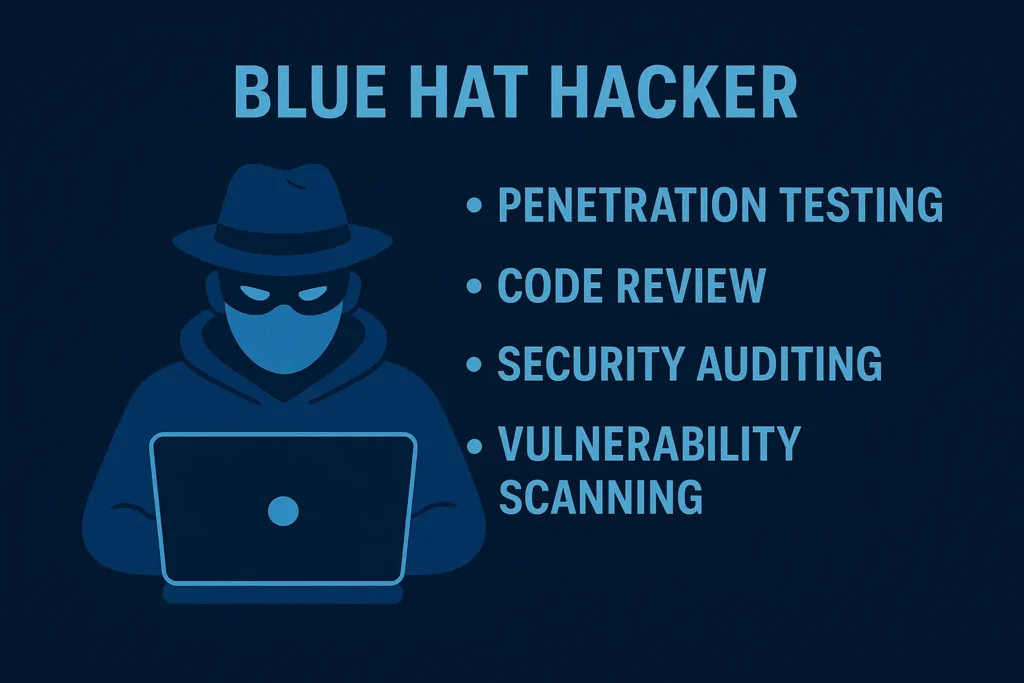
- Penetration testing: Simulating real-world attacks to see if they can break in
- Code review: Examining source code line by line to find hidden flaws
- Security auditing: Systematically checking security configurations and implementations
- Vulnerability scanning: Using automated tools to identify known security issues
2. Zero-Day Research
Some blue hat hackers specialize in finding zero-day vulnerabilities, working with the software vendor to develop patches and security measures before the vulnerability becomes public knowledge. This responsible disclosure process prevents malicious hackers from exploiting the flaw.
3. Independent Product Validation
If you’re integrating someone else’s code into your product, you want an independent expert to verify it’s actually secure. Blue hats provide that impartial assessment.
4. Extracting Intelligence from Malware
Blue hat hackers don’t just find vulnerabilities, they also analyze how attacks work. This intelligence work is crucial for staying ahead of emerging threats.
The Costs of NOT Hiring a Blue Hat Hacker
The Exponential Cost of Fixing Bugs Later
The cost to fix a bug found during the implementation phase is 6.5 times more expensive than one found during design. If the bug is found after release, it can cost 15 to 100 times more to fix. This is an important statistic to justify the onboarding of a blue hat hacker.
Source: IBM Systems Sciences Institute
Security Testing Slashes Breach Costs
Organizations with extensive testing programs saved an average of $1.59 million on breach costs compared to those with no testing.
Source: Ponemon Institute (research commissioned for IBM’s Cost of a Data Breach Report).
Blue Hat vs. White Hat: What’s the Difference?
This is where things get interesting, because at first glance, blue hat and white hat hackers seem almost identical. Both are ethical. Both work to improve security. Both require authorization. So what’s the actual difference?
Employee vs. Contractual Work
The most fundamental difference is where they stand in relation to the organization. White hat hackers are employees or long-term contractors. They’re part of the team, with company email addresses, access badges, and spots in the organizational chart. They might work as security analysts, penetration testers, or security architects within the company.
Blue hat hackers are always external. They’re brought in from outside the organization, usually on a contractual or project basis. They maintain their independence and objectivity precisely because they’re not on the payroll.
It’s the difference between your in-house mechanic and the independent inspector you bring in before buying a used car. Both are checking for problems, but one has a vested interest in the sale.
Scope and Duration: Ongoing vs. Project-Based
White hat hackers often work on continuous security. They’re monitoring systems, responding to incidents, implementing security measures, and constantly testing defenses. Their work never really stops because security never sleeps.
Blue hat hackers engage in targeted, time-limited assessments. They’re brought in for specific projects to test a particular product, system, or application before it launches.
Think of white hats as the full-time security guards, while blue hats are the specialized consultants brought in for high-stakes moments.
Perspective: Insider vs. Fresh Eyes
White hat hackers, being part of the organization, understand the internal culture, the business priorities, and the technical decisions that led to the current system design. This insider knowledge is both a strength and a potential blind spot.
Blue hat hackers bring completely fresh eyes to the problem. They’re not clouded by internal politics, business pressures, or familiarity with the codebase. They see things that people too close to the project might miss. Their outsider perspective is their superpower.
It’s like asking your spouse to proofread your writing versus hiring a professional editor. Your spouse knows you and your style, but the professional editor will catch errors your spouse overlooks simply because they’re seeing it fresh.
Specialization: Generalist vs. Specialist
White hat hackers often need broad skills to protect all aspects of an organization’s infrastructure. They might work on network security one day, application security the next, and cloud security the day after that.
Blue hat hackers frequently specialize in specific areas or technologies. A company might bring in a blue hat expert specifically for their deep knowledge of mobile app security, IoT device vulnerabilities, or blockchain security. Their specialized expertise is precisely why they’re brought in.
Approach: Reactive vs. Proactive
White hat hackers often operate in a reactive mode, responding to security incidents, investigating alerts, and maintaining constant vigilance against active threats. They’re firefighters who need to be ready 24/7.
Blue hat hackers work in a planned, proactive mode. Their assessments are scheduled in advance, with clear objectives and defined timelines. They’re not responding to emergencies—they’re preventing them.
Advisory Role: Continuous vs. Consulting
White hat hackers provide ongoing guidance, implementing security measures and training staff as part of their regular responsibilities. They’re embedded in the organization’s security strategy.
Blue hat hackers offer short-term consultation on a project-by-project basis. They deliver their findings, provide recommendations, and then typically move on to the next client. Their role is more advisory than operational.
The Essential Skills of a Blue Hat Hacker
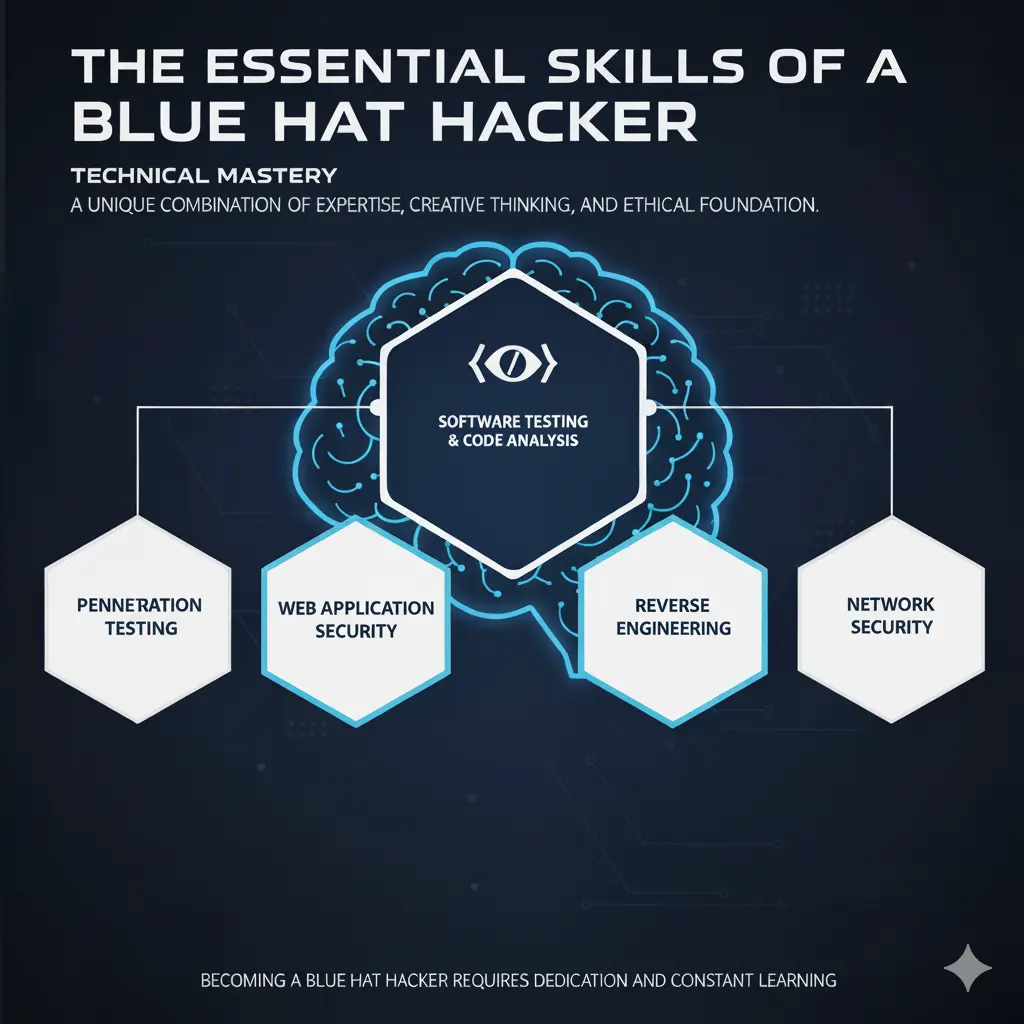
Becoming a blue hat hacker isn’t something you can do overnight. It requires a unique combination of technical expertise, creative thinking, and ethical foundation. Let’s break down what it actually takes.
Technical Mastery
Penetration Testing: This is the core skill. Blue hat hackers need to simulate real-world attacks, thinking like a malicious hacker while maintaining ethical boundaries. They must know how to exploit vulnerabilities without causing actual harm.
Web Application Security: Modern apps are built for the web, which means blue hats need deep expertise in web technologies. They must understand cross-site scripting (XSS), SQL injection, authentication bypass, and dozens of other web-specific attack vectors.
Software Testing and Code Analysis: Reading code is like reading a foreign language—except this language can have deadly flaws. Blue hats need to review source code to spot vulnerabilities that might not be obvious during functional testing.
Reverse Engineering: Sometimes the source code isn’t available. Blue hat hackers need to reverse engineer compiled software, analyzing how it works at the machine level to uncover hidden vulnerabilities.
Network Security: Understanding how data moves across networks, how protocols work, and where vulnerabilities hide in network architecture is fundamental.
Creative Problem-Solving
Here’s what separates good blue hat hackers from great ones: creativity. Anyone can run a vulnerability scanner, but it takes creative thinking to discover novel attack vectors that no one has thought of before.
Blue hat hackers need to think like both attackers and defenders simultaneously. They ask questions like: “If I were a malicious hacker, how would I approach this system? What would I try? What assumptions are the developers making that might be wrong?”
Communication Skills
Finding vulnerabilities is only half the job. Blue hat hackers need to explain what they found in ways that both technical teams and business executives can understand. A vulnerability report that nobody comprehends is useless.
They need to articulate:
- What the vulnerability is
- How serious it is
- What could happen if exploited
- How to fix it
- What the business risk looks like
Ethical Foundation
They’re given extraordinary access and trust. The temptation to misuse that access must never win.
Every action must be authorized. Every test must be within the agreed scope. Some other types of hackers may even install linux keyloggers to conduct their tests but not the blue hat hacker. Every piece of data they encounter must be treated with respect and confidentiality. One ethical lapse can destroy a career and harm the people they’re supposed to protect.
Continuous Learning
The cybersecurity landscape changes daily. New vulnerabilities are discovered, new attack techniques emerge and new technologies create new attack surfaces. Blue hat hackers who stop learning become obsolete fast.
They need to stay current with:
- The latest security research
- Emerging attack techniques
- New tools and methodologies
- Industry best practices
- Regulatory requirements
Why Blue Hat Hackers Are More Important Than Ever?
Remember Jack from the beginning of our story? His work prevented a potential disaster that could have compromised millions of users and destroyed a company’s reputation overnight. That’s not an exaggeration, it’s the reality of modern cybersecurity.
Fresh Perspective Catches What Others Miss
Internal teams, no matter how skilled, can develop blind spots. They know the system so well that they make assumptions. They’re under pressure to ship products. They might unconsciously overlook issues because admitting them means more work.
Blue hat hackers don’t have these blind spots. They’re not invested in the project’s timeline or the company’s internal politics. Their only job is to find problems, which makes them devastatingly effective.
Specialized Expertise
Technology has become incredibly specialized. A company might excel at building user interfaces but lack deep expertise in cryptographic implementations. A blue hat hacker who specializes in cryptography can catch flaws that a general security team might miss.
This specialization means that blue hats often bring expertise that simply doesn’t exist within the organization.
Cost-Effective Prevention
Prevention is better than cure, always! A security flaw discovered by a blue hat hacker might take a few days to fix. The same flaw discovered after launch could mean emergency patches, customer notifications, regulatory fines, and permanent reputation damage.
Blue hat hackers are essentially insurance—you pay for their expertise upfront to avoid catastrophic costs later.
Market Credibility
When a company can say they’ve brought in independent security experts to validate their product, it builds trust with customers. In markets where security is a selling point, having blue hat validation can be a competitive advantage.
The Future of Blue Hat Hacking
As our digital world becomes more complex, the role of blue hat hackers will only grow more critical. Every new technology creates new attack surfaces that need expert evaluation.
The best organizations understand that security isn’t a one-time checklist, rather an ongoing journey. Blue hat hackers are essential waypoints on that journey, providing the independent verification that gives companies and customers confidence in their digital security.
Ready to Join the Elite Ranks of Blue Hat Hackers?
If Jack’s story or transformation resonates with you and you are intrigued by the idea of being the last line of defense between good software and disaster, then it’s time to take the next step.
Our comprehensive cybersecurity training programs are designed to transform your curiosity into expertise.
What You’ll Master:
✓ Advanced penetration testing techniques that go beyond basic vulnerability scanning
✓ Web application security testing for modern frameworks and architectures
✓ Code analysis and reverse engineering to find vulnerabilities others miss
✓ Real-world scenarios based on actual security assessments
✓ Professional reporting and communication skills to present findings effectively
✓ Ethical hacking foundations that build your career on solid ground
Why Train With Us?
You will be taught by a cyber security professional who works on real assessments. I have discovered zero-days, presented at security conferences, and helped organizations avoid catastrophic breaches. I’ll share not just what’s in the textbooks, but what actually works in the field.
You also get personalized mentorship. Whether you’re starting from scratch or leveling up existing skills, we meet you where you are and guide you to where you want to be.
Your Path to Becoming a Blue Hat Hacker Starts Today
The cybersecurity industry is desperately short of skilled professionals. Companies are actively seeking blue hat hackers who can provide the independent validation their products need. The demand is high, the work is engaging, and the impact is real.
Don’t wait for the perfect moment; create it.
The next major data breach is being planned right now. The next critical vulnerability is waiting to be discovered. The question is: will you be the one who finds it first, before the bad guys do? Join our training programs and become the blue hat hacker who makes a difference.