
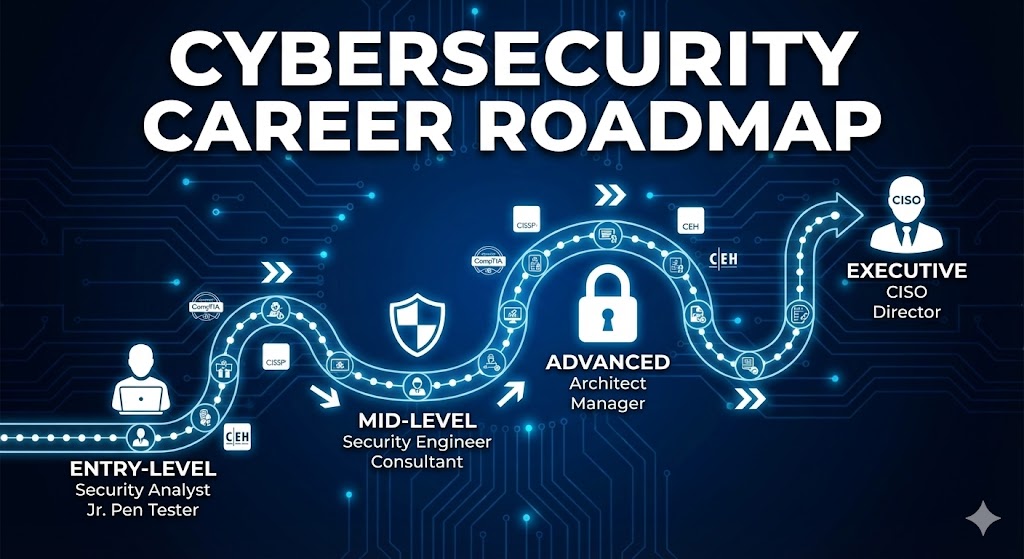
From Zero to Cyber Hero: Your No-BS Cybersecurity Career Path Roadmap to a Six-Figures
The $200K Question Nobody Asked
It is 2 AM. You’re sitting in your car crying into the steering wheel. Another double shift at the restaurant. Another $87 in tips. Another night wondering if you’d EVER escape the cycle of barely making rent. You pulled out your phone and Googled something that would change your life: “highest paying jobs without a degree.”
Cybersecurity popped up. Average salary: $120,360. Entry-level roles: $85,640. No computer science degree required. “That has to be bulls*it,” you muttered. It wasn’t.
Eighteen months later, you walked into your first day as a Security Operations Center (SOC) Analyst making $78,000 a year. Three years after that? Security Engineer at $125,000. Five years? Security Architect at $165,000.
From restaurant server to six-figure cybersecurity professional in five years. No traditional degree. No tech background. Just determination, the right roadmap, and refusing to give up when it got hard.
If you’re reading this wondering whether you can actually break into cybersecurity in 2026, the answer is yes. But you need to understand something crucial: this isn’t a six-month bootcamp fairy tale. It’s a 12-24 month intensive transformation that will fundamentally change your life—if you’re willing to put in the work.
Let me show you exactly how.
The Myth We’re Destroying Today in This Cybersecurity Career Path Roadmap
Before we dive into the roadmap, let’s kill some myths that are probably holding you back:
Myth #1: “You need a computer science degree” False. Nearly two-thirds of employers now use skills-based evaluation for entry-level hires. They want proof you can do the job, not a piece of paper saying you sat through lectures.
Myth #2: “You must be a coding genius” Also false. Some cybersecurity roles require minimal coding. GRC analysts, security auditors, and many SOC analysts succeed with basic scripting skills and strong analytical abilities.
Myth #3: “It takes 10+ years to make good money” Completely false. Entry-level roles can average $85,640 per year, with mid-level roles like SOC Analyst or Threat Intelligence Analyst averaging $107,000–$130,000. You can hit six figures in 3-5 years.
Myth #4: “Cybersecurity jobs are being automated away” Ridiculous. The cybersecurity job market offers 3.5 million unfilled cybersecurity positions globally. The demand is exploding, not shrinking.
Now that we’ve cleared that up, let’s talk about reality.
The Brutal Truth: What This Actually Takes
Here’s what nobody wants to tell you: The first year sucks.
You’ll feel stupid. You’ll Google things that seem obvious to everyone else. You’ll spend hours troubleshooting something that turns out to be a simple typo. You’ll see job postings asking for “entry-level” positions that want 3-5 years of experience and wonder what kind of sick joke the universe is playing.
But here’s the thing: everyone who’s now making $150K+ as a cybersecurity professional went through the exact same struggle. They just didn’t quit.
What you’ll actually need:
- Time: 15-20 hours per week for 12-18 months minimum
- Money: $1,500-$3,000 for certifications and training (ROI is insane, as we’ll see)
- Resilience: You’ll fail practice exams. You might fail certification attempts. That’s normal.
- Curiosity: If you don’t find technology genuinely interesting, this will be torture
Can’t commit to that? That’s okay—but be honest with yourself now rather than six months in.
Still here? Good. Let’s build your roadmap.
Phase 1: The Foundation (Months 0-6)
Where You Start Matters
Your entry point into cybersecurity depends entirely on where you’re starting from:
Complete Beginner (No IT Experience) Timeline: 12-18 months to first security job First stop: Build IT fundamentals
IT Professional (Help Desk, Sys Admin, Network Admin) Timeline: 6-12 months to first security job First stop: Security fundamentals certification
Developer/Programmer Timeline: 4-8 months to first security job First stop: Application security path
Other Professional Looking to Switch Timeline: 12-24 months depending on transferable skills First stop: GRC or foundational IT training
Let’s focus on the most common path: complete beginner.
Your First 6 Months: The Foundation Phase
Month 1-2: IT Fundamentals
Before you can secure systems, you need to understand how they work. Focus on:
- Networking basics: What’s an IP address? What are ports? How does DNS work? These aren’t just abstract concepts—they’re the language of cybersecurity.
- Operating systems: Get comfortable with Windows and Linux. Install a virtual machine. Break things. Fix things. Repeat.
- Basic command line: PowerShell for Windows, Bash for Linux. You don’t need to be a scripting wizard yet, but you should be comfortable navigating without a GUI.
Resources that don’t suck:
- Professor Messer’s free YouTube courses
- TryHackMe’s “Complete Beginner” path
- Set up a home lab (old laptop or free tier cloud resources)
Month 3-4: Security+ Certification Study
This is your golden ticket. CompTIA Security+ is the most requested entry-level certification in cybersecurity job postings. Period.
91% of employers prefer candidates with certifications, especially when those certifications prove applied skills.
What Security+ covers:
- Threats, attacks, and vulnerabilities
- Architecture and design
- Implementation
- Operations and incident response
- Governance, risk, and compliance
Study plan:
- 2 hours per day, 5 days per week
- Video course + official study guide + practice exams
- Take practice exams until you’re consistently scoring 85%+
Cost: ~$1,500 all in (course + materials + exam) Pass rate with proper preparation: 70-80%
Month 5-6: Apply, Network, Build
While studying for Security+, start:
Building your portfolio:
- Document your home lab setup
- Write blog posts explaining security concepts
- Contribute to open-source security projects
- Create a GitHub with security scripts or tools
Networking (the human kind):
- Join cybersecurity Discord/Slack communities
- Attend local security meetups (BSides conferences are goldmines)
- Connect with security professionals on LinkedIn
- Do informational interviews (people love talking about their careers)
Applying for jobs:
- Yes, even before you pass Security+
- IT Help Desk roles with security responsibilities
- Junior SOC Analyst positions
- IT Security Coordinator roles
- Apply to 10-15 positions weekly
Maria applied to 47 positions before getting her first interview. Her 52nd application got her the offer. Most people quit at application 10.
Phase 2: The Fork in the Road (Months 6-18)
Once you’ve got your foundation and landed your first security-adjacent role, you face a critical decision: What kind of cybersecurity professional do you want to be?
This isn’t a permanent choice—plenty of people switch paths later—but your initial specialization will shape your next 2-3 years.
Option A: Blue Team (The Defenders)
Blue Teams are security defenders who monitor systems 24/7, detect threats, and respond to incidents in real time.
Who thrives here:
- You’re calm under pressure
- You love solving puzzles methodically
- You’re detail-oriented (catching one anomaly among thousands)
- You enjoy building and maintaining systems
Career Path:
- Junior SOC Analyst ($75K-$85K)
- SOC Analyst II ($95K-$110K)
- Senior SOC Analyst / Threat Hunter ($110K-$130K)
- SOC Manager ($130K-$160K)
Day in the Life: You’re monitoring security alerts from your SIEM (Security Information and Event Management) system. An alert fires: unusual outbound traffic from an internal server at 3 AM. Is it:
- A legitimate automated backup?
- A compromised system exfiltrating data?
- A false positive from misconfigured logging?
You investigate logs, check traffic patterns, correlate with other alerts. It’s a compromised workstation. You isolate it, begin incident response, and prevent a major breach. Crisis averted.
Key Skills:
- Log analysis (reading and understanding system logs)
- SIEM tools (Splunk, QRadar, Azure Sentinel)
- Network traffic analysis
- Incident response procedures
- Forensics basics
Certifications to pursue:
- CompTIA CySA+ (Cybersecurity Analyst)
- GIAC GCIH (Incident Handler)
- Blue Team Level 1 (BTL1)
Pros:
- Steady work (not project-based like Red Team)
- Easier to find entry-level positions
- Strong job security
- Direct impact on protecting organizations
Cons:
- Can involve shift work (24/7 SOC operations)
- Alert fatigue is real
- High-stress during actual incidents
- Lots of false positives to sift through
Option B: Red Team (The Attackers)
Red Teams are ethical hackers who simulate real cyberattacks to find vulnerabilities before criminals do.
Who thrives here:
- You love breaking things (ethically)
- You’re creative and think outside the box
- You enjoy the challenge of outsmarting defenses
- You’re competitive and persistent
Career Path:
- Security Analyst / Junior Pentester ($85K-$100K)
- Penetration Tester ($110K-$140K)
- Senior Pentester / Red Team Operator ($140K-$180K)
- Lead Pentester / Red Team Lead ($170K-$220K+)
Day in the Life: You’re contracted to test a financial company’s security. You start with reconnaissance—what can you learn publicly? You discover an employee’s LinkedIn mentioning specific software versions. You craft a targeted phishing email. One employee clicks. You’re in.
Now the real work begins: lateral movement, privilege escalation, finding the crown jewels. You document everything because the goal isn’t just to break in—it’s to show them how you did it so they can fix it.
Key Skills:
- Penetration testing methodologies
- Exploitation techniques
- Programming (Python, Bash, PowerShell)
- Web application security
- Social engineering
- Report writing (explaining technical findings to non-technical people)
Certifications to pursue:
- CEH (Certified Ethical Hacker)
- eJPT (eLearnSecurity Junior Penetration Tester)
- OSCP (Offensive Security Certified Professional) – the gold standard
The average salary range for a penetration tester is between $115k to $203k per year.
Pros:
- Extremely engaging work (every engagement is different)
- Higher salary ceiling
- Respected specialty
- Creative problem-solving daily
Cons:
- Harder to break in at entry level (competitive)
- Constant learning curve (new exploits, techniques)
- Stressful client deliverables and deadlines
- Report writing is tedious but critical
Reality check: The uniqueness of offensive roles makes them more appealing due to higher salaries and greater opportunities for personal achievement, which means more competition. Most successful pentesters spent 2-3 years in Blue Team roles first, learning how defenders think.
Option C: Purple Team (The Hybrid – The Future)
Don’t want to choose? Good news: Purple team integrates defensive and offensive tactics to promote collaboration and shared knowledge between red teams and blue teams.
Purple Team professionals understand both offense and defense, making them incredibly valuable. They can simulate attacks AND build better defenses.
Career path:
- Security Engineer ($100K-$130K)
- Detection Engineer ($110K-$145K)
- Security Architect ($150K-$200K+)
Best for: People who want variety, enjoy both breaking and building, and think strategically about security.
Option D: GRC (The Non-Technical Path)
GRC specialists evaluate risks and develop security standards, procedures, and controls to manage them.
If you’re less interested in technical implementation and more interested in policy, compliance, and risk management, GRC might be your path.
Career path:
- GRC Analyst ($70K-$90K)
- Compliance Manager ($95K-$120K)
- Risk Manager ($110K-$145K)
- Chief Compliance Officer ($150K-$220K+)
The average salary range in GRC is between $88k to $192k per year.
Who thrives here:
- Strong communicators
- Detail-oriented
- Enjoy documentation and frameworks
- Business-minded
The best part: Lower technical barrier to entry. You can start with Security+ and pivot into GRC faster than pure technical roles.
Option E: Cloud Security (The Growth Rocket)
Everything’s moving to the cloud, which means cloud security roles show steady demand with salaries of $132,000–$198,000 due to cloud misconfigurations being the #1 cause of major breaches.
Career path:
- Cloud Security Analyst ($90K-$110K)
- Cloud Security Engineer ($115K-$150K)
- Cloud Security Architect ($160K-$210K+)
Required knowledge:
- AWS, Azure, or Google Cloud expertise
- Container security (Docker, Kubernetes)
- Infrastructure as Code (IaC) security
- Cloud-native security tools
Certifications:
- AWS Certified Security Specialty
- Azure Security Engineer Associate
- CCSP (Certified Cloud Security Professional)
Making The Choice: The Decision Framework
Ask yourself:
-
Do you prefer breaking or building?
- Breaking → Red Team
- Building → Blue Team
- Both → Purple Team
-
Do you want high technical depth or business interaction?
- Technical depth → Red/Blue Team
- Business interaction → GRC
-
What’s your stress tolerance?
- High stress, high reward → Red Team
- Moderate stress, steady work → Blue Team
- Lower stress, predictable hours → GRC
-
Where’s your passion?
- If you don’t get excited thinking about it, choose differently
Neither role is inherently better—it depends on your interests and skill set. The best cybersecurity professionals are those who genuinely love what they do.
Phase 3: Building Momentum (Months 18-36)
You’ve got your foundation. You’ve chosen your path. Now it’s time to become genuinely good at it.
The 2-3 Year Grind
This is where most people plateau—and where you’ll separate yourself from the pack.
Your focus:
- Deep specialization in your chosen path
- Advanced certifications
- Hands-on projects that prove expertise
- Building your professional network
For Blue Team:
- Master your SIEM platform completely
- Learn threat hunting methodologies
- Study malware analysis basics
- Pursue CySA+, then start eyeing CISSP
For Red Team:
- Complete OSCP (yes, it’s hard, that’s the point)
- Participate in bug bounty programs
- Build custom tools and exploits
- Develop reporting skills
For GRC:
- Deep dive into frameworks (NIST, ISO 27001, CIS Controls)
- Understand compliance requirements (GDPR, HIPAA, SOC 2)
- Pursue CISA or CISM
- Develop business communication skills
Salary progression during this phase:
- Year 1: $75K-$85K
- Year 2: $90K-$110K
- Year 3: $110K-$130K
Phase 4: The Six-Figure Breakthrough (Years 3-5)
This is where it gets real. You’re no longer a junior anything. You’re a professional with proven skills, and the market rewards that.
Senior-level roles opening up:
- Senior Security Analyst ($110K-$130K)
- Security Engineer ($120K-$150K)
- Senior Penetration Tester ($140K-$180K)
- Security Architect ($150K-$200K+)
What separates senior from mid-level:
- Independence: You don’t need hand-holding
- Mentorship: You can train junior team members
- Strategic thinking: You understand the “why” not just the “how”
- Business acumen: You can explain technical risks to executives
The certification that changes everything: CISSP
One of the top-paying cybersecurity positions in 2026, with senior architects in the U.S. often exceeding $260K.
CISSP isn’t just a certification—it’s a signal that you’ve reached professional maturity in cybersecurity. It requires 5 years of experience (or 4 with a degree), covers eight domains of security knowledge, and commands serious respect.
Cost: ~$4,000 all in Salary impact: +$20K-$40K annually ROI: Pays for itself in 2-3 months
The Skills That Actually Matter
Let’s talk about what separates successful cybersecurity professionals from those who struggle:
Hard Skills (The Technical Stuff)
Must-Have Foundation:
- Networking (TCP/IP, DNS, firewalls, VPNs)
- Operating systems (Windows, Linux)
- Command line proficiency
- Basic scripting (Python or PowerShell)
- Security fundamentals (threats, vulnerabilities, controls)
Level Up:
- SIEM tools (Splunk, ELK, Sentinel)
- Cloud platforms (AWS, Azure, GCP)
- Vulnerability assessment tools (Nessus, Qualys)
- Penetration testing tools (Metasploit, Burp Suite, Nmap)
- Log analysis and correlation
Advanced:
- Malware analysis
- Exploit development (for Red Team)
- Security architecture design
- Threat intelligence
- Forensics
Soft Skills (The Career Accelerators)
Here’s what nobody tells you: After about 3 years, technical skills become baseline expectations. Soft skills determine who advances.
Critical soft skills:
Communication: Can you explain a SQL injection vulnerability to the CFO? Can you write a report that executives actually read?
Problem-solving: When alerts fire at 3 AM and nothing makes sense, can you methodically figure it out?
Business acumen: Do you understand why security decisions have business implications? Can you calculate risk in dollars, not just technical impact?
Continuous learning: The threats change monthly. The tools change yearly. Can you keep up?
Teamwork: Lone wolf security professionals don’t advance. Can you work with developers, IT operations, and business leaders?
Maria’s secret weapon wasn’t her technical skills—plenty of people were more technical. It was her ability to explain security risks in business terms. While other analysts talked about CVE scores, she talked about potential revenue loss and regulatory fines. That’s what got her promoted.
The Money Timeline: Real Salary Progression
Let’s get specific about what you can actually expect to earn:
Year 1: Entry-level position ($75K-$85K)
- Help Desk with security focus or Junior SOC Analyst
- Building foundation, learning tools, supporting senior team members
Year 2: Junior specialist ($85K-$95K)
- SOC Analyst, Security Analyst, Junior Pentester
- Handling incidents independently, contributing to projects
Year 3: Mid-level professional ($95K-$115K)
- SOC Analyst II, Security Engineer, Penetration Tester
- Leading investigations, managing projects, mentoring juniors
Year 4: Senior professional ($115K-$140K)
- Senior Analyst, Senior Engineer, Senior Pentester
- Subject matter expert, complex problems, strategic input
Year 5: Specialist or Team Lead ($130K-$165K)
- Lead Engineer, Security Architect, SOC Team Lead
- Architecture decisions, team leadership, cross-functional projects
Year 7-10: Management or Principal ($150K-$220K+)
- Security Manager, Principal Architect, Director
- Strategic planning, budget ownership, executive communication
Year 10+: Executive ($180K-$400K+)
- CISO positions average $245,000–$270,000+ per year
- C-level security leadership, board interaction, organizational strategy
Geographic multipliers:
- San Francisco/NYC/Seattle: +30-50%
- Remote roles: National average
- Midwest/South: -10-20%
This isn’t theory. This is the actual career trajectory of hundreds of successful cybersecurity professionals.
Your Next 90 Days: The Action Plan
Enough reading. Time for action.
Week 1: Assessment
- [ ] Take technical aptitude quiz (free online)
- [ ] Evaluate current financial situation (can you invest $1,500-$3,000?)
- [ ] Assess time availability (15-20 hours/week realistic?)
- [ ] Choose your path (Blue/Red/GRC/Cloud)
Weeks 2-4: Foundation
- [ ] Set up home lab (VM or cloud)
- [ ] Start Professor Messer Security+ videos (free)
- [ ] Join 3 cybersecurity communities
- [ ] Create LinkedIn profile focused on security
Weeks 5-8: Deep Dive
- [ ] Purchase Security+ study materials
- [ ] Study 2 hours daily
- [ ] Build first portfolio project
- [ ] Attend first security meetup
Weeks 9-12: Momentum
- [ ] Schedule Security+ exam (creates deadline pressure)
- [ ] Take practice exams weekly
- [ ] Apply to 5 entry-level positions weekly
- [ ] Do 2 informational interviews with professionals
The Commitment
This isn’t easy. Maria cried in her car more than once during her first year. She failed her Security+ exam the first time. She applied to 52 jobs before getting an offer.
But she didn’t quit.
And five years later, she makes $165,000 as a Security Architect, works remotely, and has zero regrets about those hard 18 months of transformation.
The Reality Check: Can You Actually Follow This Cybersecurity Career Path Roadmap?
I’m going to be blunt: Not everyone succeeds at this.
About 40% of people who start down this path quit within the first 6 months. Another 30% quit before landing their first security job.
You’ll struggle if:
- You expect quick results (this takes 12-24 months minimum)
- You’re not genuinely interested in technology
- You give up after failing once
- You’re looking for easy money (the money is great, but earned)
You’ll succeed if:
- You’re willing to feel stupid for 12-18 months while learning
- You can commit 15-20 hours weekly
- You’re resourceful and persistent
- You genuinely enjoy solving complex problems
The cybersecurity industry desperately needs people. The U.S. Bureau of Labor Statistics projects a 29% growth rate in the employment of information security analysts from 2024 to 2034. That’s 3-4x faster than average occupations.
53% of U.S. employers are willing to increase starting compensation for candidates with in-demand cybersecurity skills.
The opportunity is there. The question is: are you?
Ready to Start Your Transformation?
Maria started with nothing but determination and a laptop. No degree. No experience. No connections.
She’s proof that this path works—but only if you actually walk it.
Our comprehensive cybersecurity training programs give you everything Maria had to figure out the hard way:
✓ Structured learning paths for each specialization (Blue/Red/Purple/GRC/Cloud)
✓ Certification preparation with instructor-led training and practice exams
✓ Hands-on labs where you practice on real systems, not just theory
✓ Portfolio project guidance so you have proof of skills for employers
✓ Career coaching including resume optimization and interview prep
✓ Community access to learn with peers and get support when stuck
✓ Job placement assistance with employer connections and hidden job market access
✓ Mentorship from working cybersecurity professionals who’ve walked this path
The Investment That Changes Everything
Remember: Entry-level roles average $85,640 per year. Investing $3,000-$6,000 to get there means your training pays for itself in roughly 2-3 weeks of work in your new career.
Maria spent $3,200 total on her first year of training and certifications. Her annual income increased by $30,000 in year one. That’s 940% ROI.
Don’t navigate this alone.
The difference between people who succeed and those who quit is often just having guidance and support when things get hard.
[Enroll in our cybersecurity training programs today] and start your transformation from where you are now to where you want to be.